Breaking the Marmont Cipher1809
A Napoleonic war briefing, unread for 217 years
A letter to General Marmont has sat on the standard list of unsolved historical ciphers, known only from a single reproduction in a 1969 French army journal that carries the wrong date.[1] This post gives a full working reading, produced end-to-end from that single scanned plate, redates the letter to March 1809, and places it in the two weeks before Austria invaded Bavaria. The full solution package, with a script that regenerates the reading, is available for download.
Two weeks before the war
In February 1809, Vienna decided on war.[23] Napoleon had deposed the Spanish Bourbons the previous spring and taken their kingdom for his brother, and Vienna concluded that the Habsburgs were next unless it struck while his best troops were tied down in Spain.[24][23] On 8 February the Austrian Empire resolved to fight Napoleon, with the war party pointing at the French disaster at Bailén in Spain, where an entire French corps had surrendered the previous July.[26][25] Archduke Charles was the Austrian Emperor's younger brother and the best general the Habsburgs had.[19] He had spent three years rebuilding the army: 340,000 regulars, plus a new Landwehr militia on paper at 240,000.[26][27] Everyone could see what was coming.
Napoleon had a specific problem, and its name was Marmont.
Marmont, a personal friend of the Emperor, had been entrusted with what were called the "finest" troops in the theater (about 13,000 men by Napoleon's own count), and they were parked in Dalmatia on the far side of the Adriatic.[29][11] Austrian territory sat between them and every other French army. If war came, Marmont would be the most isolated general in the Empire.
So on 16 March 1809, Napoleon wrote from Paris to his stepson Eugène, the Viceroy of Italy, and told him to send Marmont a letter.[18] It was to lay out where every French and allied army stood. It was to go "dans une lettre chiffrée et par un officier intelligent": in cipher, carried by an intelligent officer.[10]
That letter, or one written to exactly that order, survives. Its first line is in plain French:[3]
Vous avez dû recevoir, Monsieur le Général Marmont, mes lettres des 8, 14 et 20 courant.
You must have received, General Marmont, my letters of the 8th, 14th and 20th of this month.
then 24 rows of cipherAfter that come twenty-four rows of two-digit numbers, stray letters, and invented symbols.
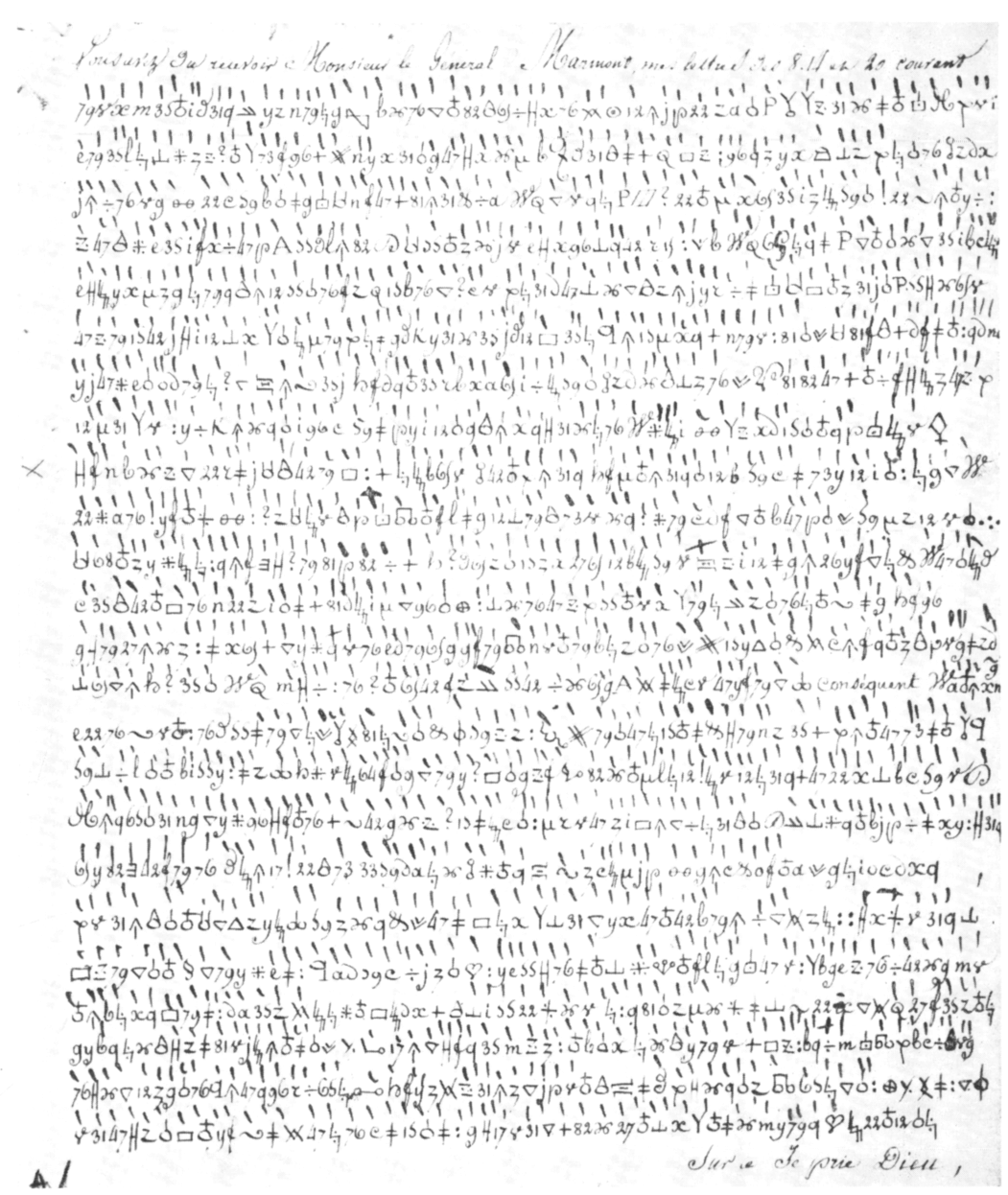
The key didn't survive, and for 217 years nobody alive could read it.
Why this one
I've never broken a cipher. A week ago I saw Carter Leffen's post (cool name) about reading a 1941 German Army Enigma message that had been listed as unsolved for decades. He isn't a cryptographer either, but Astra (GPT-6) doesn't mind: it worked the problem for about ten hours.[5]
That led me to Satoshi Tomokiyo's Cryptiana - the product of decades of one man's careful work documenting unsolved ciphers. His entry for it, listed as "Encoded Letter to Marshal Marmont (1807)", gives the clear first line and describes the system. It also notes that Marmont was using a code of only about 150 entries in 1811, so this one probably isn't large.[3][9]
Tomokiyo's site now points solvers to check against another guy, Daniel Bourdeau, who has read or partly read more than thirty ciphers from these lists in the last few weeks seemingly using foundation models as well. I read through his notes, saw he had attempted this one but stopped short, and wanted to see what I could do with it.[3][4]
“There is nothing to work on”
That has been the standing verdict on this cipher. The most recent solver notes on record put it flatly:
There is nothing to work on. The ciphertext is not published anywhere I can reach.[4]
Tomokiyo's page quotes only the first line (the line you read above), and the rest exists solely as the plate shown in Lieutenant-Colonel J. Vilcoq's 1969 article in the Revue historique des Armées.[3][1] Stop looking there and the trail goes cold.
It shouldn't. The journal is online, on Persée, the French academic archive. The plate sits after printed page 24. It's 1,202 by 1,836 pixels, roughly nineteen pixels per sign.[1][6] A partial table for this cipher, compiled by the French cryptology historian Daniel Tant and hosted by ARCSI, already documents 33 letter values. Every one of its word-sign cells is blank.[2] Those two files are where this work begins.
How it reads
The letter has 1,300 cipher units and 155 distinct signs.[6] It's a homophonic cipher: common letters get several interchangeable signs, so that counting frequencies gets you nowhere.[7]
Tant's 33 published values account for 435 of the 1,300 units. The other two-thirds had to be worked out from the letter itself.[2][6]
- 435readable from Tant's table · 33%
- 865worked out from the letter · 67%
This took about six hours of model execution time with GPT-6 Astra, and everything below came out of one image. There was no transcription to start from, because none existed: Astra cut the 1,202 by 1,836 plate into rows, read the signs, decided which of 175 hand-drawn marks were the same sign written twice, and only then began breaking the cipher. Transcription and cryptanalysis are usually separate skills, often separate careers. Here they ran as one workflow, and the plate stayed in the loop: proposed values were checked back against every occurrence of a sign on the image.[6]
How the key was found
- Transcribe. The plate was cut into row crops and read line by line. Every visibly different mark got a provisional name, with potential pen variants kept separate. This work reconciled the sections into 1,320 units and 175 provisional labels.[6]
- Fix what is already known. Tant's 33 letter values were taken as given. The ten ordinary letters spelling “CONSEQUENT” in row 14 were kept as plain text. Between them, this covered about a third of the units before any new search began.[2][6]
- Search. A solver assigned letters to the remaining signs by simulated annealing, scoring each candidate plaintext against French letter statistics (3-, 4- and 5-grams) drawn from Hugo, Dumas and Marmont's own memoirs.[8][6]
- Find the word-signs. Signs that kept breaking otherwise good French were tested as whole words instead of letters. Twenty-nine of them turned out to be words: de, que, les, vous, général and the rest. Two more stand for a doubled S.[6]
- Check every sign against the plate. Wherever a sign's proposed value made the French smoother, that proposition was compared with every other occurrence of that sign. The value was kept only if this benefit was realized across all instances.[6]
- Try to break it. The solver was rerun from scratch with Marmont's memoirs and every Napoleonic text removed from its language model. It recovered the same reading, so the key does not depend on the model having seen the history it was decoding.[6]
What a solution looks like
The solution to a cipher like this is an answer key, and it is the same object the clerk in Eugène's office had on his desk in March 1809. French headquarters worked from a pair of sheets: a tableau chiffrant, plain text down the left with the signs to use beside it, and its inverse, the tableau déchiffrant, for the officer at the other end.[1][3] The clerk went through the Viceroy's draft one letter at a time, choosing among the signs on offer for each, so that no two E's in a row need look alike, and dropped in a null now and then for good measure.[6] Marmont's own headquarters used a code of only about 150 entries in 1811, with nine different figures for E, and the British staff officer George Scovell broke it within two days, helped by the plain words Marmont's clerks kept leaving mixed in with the cipher.[3][9] Whoever wrote this letter was more careful.
What follows is the tableau chiffrant rebuilt. Down the left, the plain text: the twenty-six letters, then the fifteen whole French words that got a sign of their own. Most of the signs are things a clerk could write quickly: two-digit numbers, ordinary letters, Greek letters, a handful of typographic symbols. About seventy are invented marks with no printed equivalent. The full key applied to all 1,300 units, in order, with no corrections, produces the French that the rest of this post is built on.[6]
A11


B2


C4


D4


E9




F3


G4


H6


I5


J3



K2


L4



M5


N7



O5




P4


Q3


R6


S6


T9





U4


V4


W–
X2


Y2


Z1

deof2


enin1

etand3


generalgeneral1

ilhe1

jeI1

lathe2


lethe2


lesthe3


nenot2


parby1

pasnot1

pourfor1

quethat4


vousyou2


ssdoubled s2


,comma2


nullnothing4




Tant’s published signs Newly deciphered signs Unresolved, shown with our best guess
For example, take "le duc de Danzig" from row 3, sign by sign:
▼LE▼D▼U▼C▼DE▼D▼A▼N▼Z▼I▼GEvery sign, value and address above is in the solution package: key.tsv for the key, revised_tokens.txt for the transcription, and verify.py to run one against the other.
The letter
Applied in order, with no corrections, the tableau chiffrant gives:
[Those letters] contained the orders and instructions which [His Majesty] charged me to give you. I hasten today to acquaint you with the disposition of French and allied armies. The Duke of Danzig, at the head of forty thousand Bavarians, occupies Munich and Passau. Prince Poniatowski, at the head of thirty thousand Poles, is camped on the Vistula, threatening Cracow. The Prince of Ponte-Corvo commands the Saxon army, camped in front of Dresden, and the Duke of Auerstaedt occupies Bayreuth with eighty thousand French troops. The Duke of Rivoli commands sixty thousand men quartered at Ulm and Donauwörth. [General] Oudinot, with the elite corps comprising forty thousand men, is at Augsburg and along the Lech.
The Russians are marching against Austria, and the army [of] Friuli today numbers eighty thousand men. Add the Dalmatian corps, without counting the reserves being organized everywhere in the rear, and you see that Austria will be attacked at once on every side. She is consequently hastening toward her ruin. When you receive the order to march, you must not allow yourself to be intimidated by a few troops or a gathering of rabble.
I continue to await news from you with impatience. The Austrians are still at Laybach, Klagenfurth, Villach and Salzburg, and appear to threaten the Tyrol by way of Lintz. Yet one would think that they are considering sending troops into Galicia to oppose the Russians. These dispositions would suggest that their campaign plan has been upset before war has even been declared. There is, however, still nothing definite. The militia have been called into active service, and although efforts have been made to excite people, it has not yet been proved that these levies will provide much reinforcement for the army.
Renfermant les ordres et instructions que [Sa Majesté] m'a chargé de vous donner. Je m'empresse aujourd'hui de vous donner connaissance de la position d'armées françaises et alliées. Le duc de Danzig à la tête de quarante mille Bavarois occupe Munich et Passau. Le prince Poniatowski à la tête de trente mille Polonais est campé sur la Vistule, menaçant Cracovie. Le prince de Ponte-Corvo commande l'armée saxonne campée en avant de Dresde et le duc d'Auerstaedt occupe Bayreuth avec quatre-vingt mille Français et le duc de Rivoli commande soixante mille hommes cantonnés à Ulm et Donaverth. Le [général] Oudinot avec le corps d'élite formant quarante mille hommes est à Augsbourg et sur le Lech.
Les Russes marchent sur l'Autriche et l'armée [du] Frioul est aujourd'hui de quatre-vingt mille hommes. Ajoutez à cela le corps d'armée de Dalmatie, sans comprendre les réserves qui s'organisent de toutes parts sur les derrières et vous voyez que l'Autriche sera attaquée à la fois sur tous les points et elle court par conséquent à grands pas vers sa perte et vous ne devez, alors que vous recevrez ordre de marcher, vous en laisser imposer par quelques troupes ou un rassemblement de canailles.
J'attends toujours de vos nouvelles avec impatience. Les Autrichiens sont toujours à Laybach, Klagenfurth, Villach et Salzburg et semblent menacer le Tyrol par Lintz et cependant on croirait qu'ils songent à porter des troupes en Galicie pour s'opposer aux Russes. Ces dispositions feraient présager que leur plan de campagne est dérangé avant que la guerre soit encore déclarée et il n'y a toutefois rien encore de positif. Les milices sont mises en activité et quoiqu'on ait cherché à monter les têtes, il n'est pas encore prouvé que ces levées soyent d'un grand renfort pour l'armée.
Download the solution package (zip, 4 MB). Everything behind this post: the source plate, the transcription, the key with every glyph, the literal output, the editorial French and English, the row-by-row decoding, the remaining sign alternatives, and verify.py and reproduce.py, which check the files and regenerate the reading offline. Open START_HERE.html first. SHA-256: a5292f07…e9f750.
The original ask
Let's also take a look at the order that prompted our letter to be written. On 16 March Napoleon told Eugène to send Marmont, in cipher, the position of every French and allied army. Unsurprisingly, the cipher letter lists the same seven forces the order does, in the same sequence, with the same figures:[10]
| Force | Napoleon to Eugène, 16 March 1809 | The cipher letter |
|---|---|---|
| Duke of Danzig, Bavarians | 40,000, between Munich and Passau | forty thousand, Munich and Passau |
| Poniatowski, Poles | 30,000, Vistula, threatening Cracow | thirty thousand, Vistula, threatening Cracow |
| Ponte-Corvo, Saxons | before Dresden | in front of Dresden |
| Duke of Auerstaedt | 80,000, Bayreuth | eighty thousand, Bayreuth |
| Duke of Rivoli | 60,000, Ulm and Donauwörth | sixty thousand, Ulm and Donauwörth |
| Oudinot | 40,000, Augsburg and the Lech | forty thousand, Augsburg and the Lech |
| Russians | marching on Austria | marching on Austria |
The titles are Napoleon's marshals: the Duke of Danzig is Lefebvre, the Prince of Ponte-Corvo is Bernadotte, the Duke of Auerstaedt is Davout, and the Duke of Rivoli is Masséna. Oudinot commanded the grenadier reserve. Poniatowski led the army of the Duchy of Warsaw, Napoleon's Polish client state.[21]
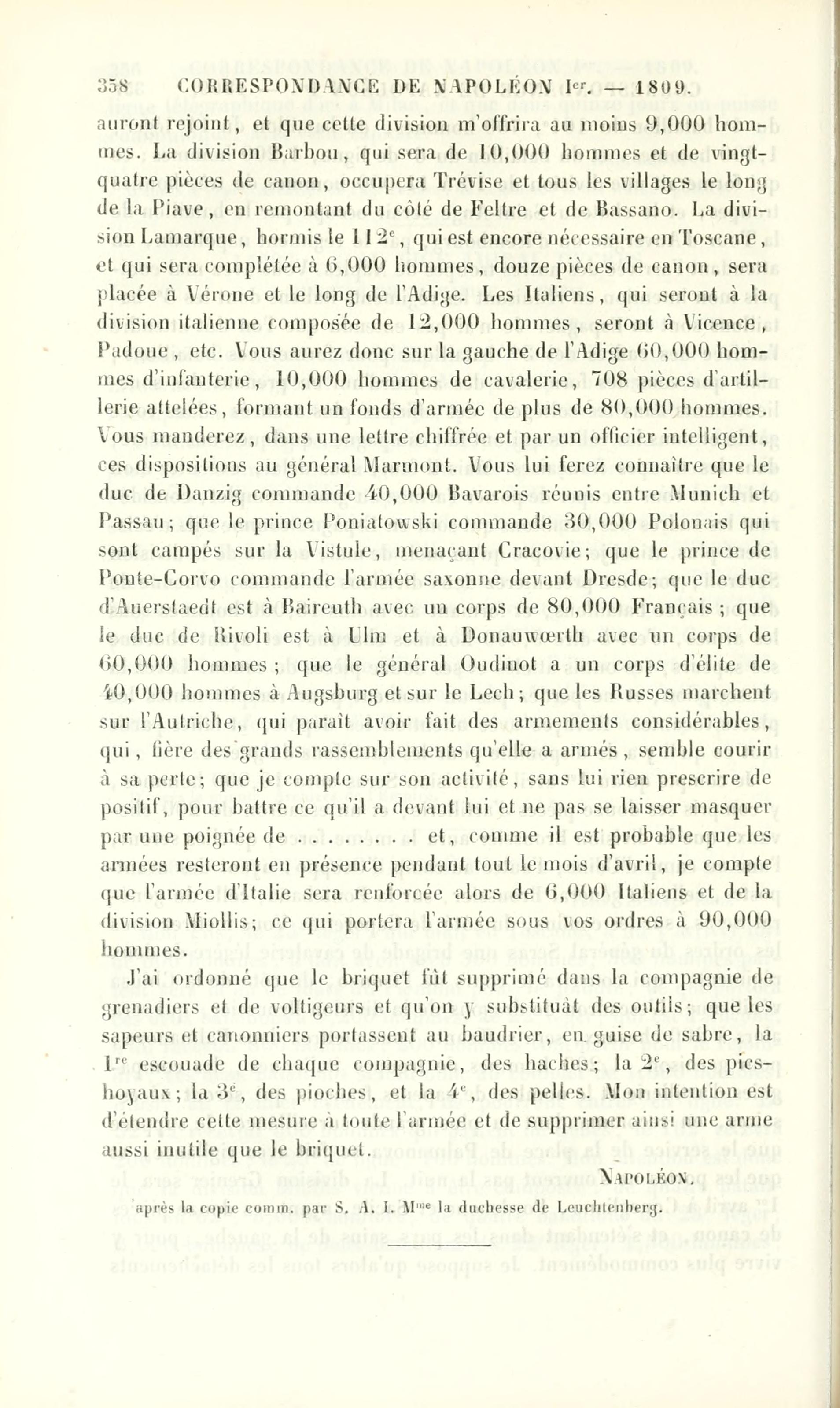
Correspondance de Napoléon Ier · vol. 18, p. 358 · no. 14908 · Napoleon to Eugène, Paris, 16 March 1809 · in English
The page begins mid-sentence: Eugène's own army, division by division
… will have joined, and that this division will give me at least 9,000 men. The Barbou division, which will be 10,000 men and twenty-four guns, will occupy Treviso and all the villages along the Piave, going up toward Feltre and Bassano. The Lamarque division, except the 112th, which is still needed in Tuscany, and which will be brought up to 6,000 men and twelve guns, will be placed at Verona and along the Adige. The Italians, who will be in the Italian division of 12,000 men, will be at Vicenza, Padua, etc. You will therefore have on the left of the Adige 60,000 infantry, 10,000 cavalry, 708 pieces of horse-drawn artillery, forming a core army of more than 80,000 men.
You will send, in a ciphered letter and by an intelligent officer, these dispositions to General Marmont. You will let him know that the Duke of Danzig commands 40,000 Bavarians assembled between Munich and Passau; that Prince Poniatowski commands 30,000 Poles who are camped on the Vistula, threatening Cracow; that the Prince of Ponte-Corvo commands the Saxon army before Dresden; that the Duke of Auerstaedt is at Bayreuth with a corps of 80,000 French; that the Duke of Rivoli is at Ulm and at Donauwörth with a corps of 60,000 men; that General Oudinot has an elite corps of 40,000 men at Augsburg and on the Lech; that the Russians are marching on Austria, which appears to have made considerable armaments, and which, proud of the great forces it has assembled, seems to be running to its ruin; that I count on his activity, without prescribing anything definite to him, to beat what he has in front of him and not to let himself be masked by a handful of . . . . . . . . and, as it is probable that the armies will remain facing each other throughout the month of April, I count on the Army of Italy being reinforced by then with 6,000 Italians and the Miollis division, which will bring the army under your orders to 90,000 men.
The page ends with an order about sabres
I have ordered that the briquet be done away with in the grenadier and voltigeur companies and that tools be substituted for it; that the sappers and gunners carry on the shoulder-belt, in place of a sabre, in the 1st squad of each company axes, in the 2nd mattocks, in the 3rd picks, and in the 4th shovels. My intention is to extend this measure to the whole army and thus do away with a weapon as useless as the briquet.
Napoleon.
From the copy communicated by H.I.H. Madame the Duchess of Leuchtenberg.
Napoleon kept at it. On 24 March he told Eugène to stop letting Frenchmen cross Austrian territory to reach Dalmatia, and to write to Marmont in cipher again to hurry his preparations. On 27 March he assumed Eugène was writing Marmont "by every courier, by land and by sea."[14]
The letter was written in the last days of March 1809, after Eugène's letter of the 20th and before Austria crossed the Inn on 10 April.[16][23]
How the forecast held up
The letter was a forecast. Here is how it aged, claim by claim, in a war most people have never heard of:
The enemy was exactly where the letter said. The letter places the Austrians at Laibach, Villach and Salzburg and says they threaten the Tyrol "by way of Lintz." On 10 April, Archduke Charles crossed the Inn into Bavaria without declaring war.[23] The same morning his younger brother, Archduke John, crossed into Italy with two corps that had marched from Villach and Laibach.[20][31] A division under Jellacic came down from Salzburg toward Munich.[32] And a corps under the Marquis de Chasteler moved out of Carinthia, occupied Lienz, and marched on Innsbruck as the Tyrol rose in revolt.[22][32] Essentially, someone in that office knew where the enemy was assembling two weeks before he moved.
Napoleon’s friends were not. The letter told Marmont Austria was "hastening toward her ruin." Six days into the war, John beat Eugène at Sacile and chased him back to Verona.[31] The letter credited Poniatowski with thirty thousand Poles. In reality, he had about 17,000, fought a drawn battle at Raszyn on 19 April, and handed Warsaw to the Austrians four days later.[33][21]
The Russians were a press release. "The Russians are marching against Austria" is the one line in the letter that was policy rather than fact. On 21 March Napoleon had ordered Eugène to "inculcate by every means, through newspaper articles or otherwise, the idea that the Russians are marching on Austria."[12] Three days later he wrote to his ambassador in St Petersburg: "You do not tell me where the Russian troops are. If Russia does not march, I shall have Austria on my hands alone."[13] He did. The Tsar had promised at Erfurt to march and had privately assured Vienna he would avoid every collision.[28][23] His army crossed into Galicia on 3 June, when the war was nearly decided.[33]
Then Napoleon lost a battle. Nobody in that office could have imagined it: on 21 and 22 May, crossing the Danube below Vienna, he was beaten at Aspern-Essling by the same Archduke Charles, his first defeat in a major battle in ten years.[39] Marshal Lannes, one of his closest friends, died of his wounds.[39] Emperor Francis wrote that his brother was "the first to interrupt the fifteen years of military fortune of the proud enemy."[39]
Marmont's push. The letter told him not to be intimidated by "a few troops or a gathering of rabble." In the last days of April the rabble attacked first: Grenzer, the Croatian border militia Austria kept on its Ottoman frontier, drove his men off the Zrmanja heights in a rainstorm.[29][30] Then the letter's conclusion held after all. In mid-May Marmont attacked again, beat the Austrians at Pribudić, captured their commander Stoichevich, fought through Gračac and Gospić, and on 3 June marched into Laibach, the first town on the letter's list of enemy positions.[29] He kept going. His Army of Dalmatia reached the Danube in time for the second day of Wagram on 6 July, the largest battle Europe had ever seen, some 300,000 men on a flat plain under a thousand guns.[40][34] Austria lost, and lost the war with it.[40]
The ending. Napoleon made Marmont a marshal, with a note saying "between ourselves, you have not done enough to justify entirely my choice."[17] At the peace of Schönbrunn in October, Austria gave up a sixth of its subjects and its whole Adriatic coast.[41] Napoleon bundled those lands into the Illyrian Provinces, made Marmont their governor, and gave him a capital: Laibach.[35] The most isolated man in the Empire ended the year ruling the town the letter had warned him about.
If you want the whole war in half an hour, Epic History TV's two animated episodes are the best short introduction I know: Aspern-Essling 1809 (19 minutes) and Wagram 1809: Napoleon's Revenge (14 minutes).
So What Happened to Marmont?
In March 1809, Marmont was a divisional general on the wrong side of the Adriatic, reading a cipher letter about armies he could not see telling him where the enemy was and told him to march when the order came. He did execute, and the march is why he is remembered at all.[17]
He spent two years in Laibach building roads and schools, introducing the Code Napoléon, and putting locals into office in their own languages, and it is the one stretch of his career that nobody argues about.[35] The baton, grudging note and all, followed him to Spain, where Wellington broke his army at Salamanca in July 1812 and a shellburst broke his arm.[36]
Then the ending everyone knows him for. In April 1814, with the Allies at the gates of Paris, Marmont came to a private arrangement with them and marched his corps into their lines. It was the act that convinced Napoleon he had to abdicate.[37][17] "I made him a marshal and a duke, and he vilely betrayed me," the Emperor said, and the French language agreed: for a generation raguser, from his title Duke of Ragusa, meant to betray.[17] He served the Bourbons, voted to shoot Marshal Ney, and in 1830 was the general who failed to hold Paris for Charles X, who asked him to his face, "Will you betray us, as you betrayed him?"[17]
Marmont went into exile with the king, tutored Napoleon's son in Vienna, and died in Venice in 1852, the last of the marshals.[37] He spent his final years writing nine volumes of memoirs to argue his case, and that is where this letter comes back in. Volume three prints Eugène's letters to him of 8, 14 and 20 March 1809, the three the cipher's first line acknowledges.[38][16]
New to the record
Napoleon's order of 16 March has been in print since 1865.[10] What nobody had was the other end of it: what actually got said to the general on the far side of the Adriatic.
The first thing it adds is a missing word. In the printed edition, Napoleon's sentence to Marmont breaks off. Marmont is to beat what is in front of him and not let himself be masked "par une poignée de . . . . . . . ." (by a handful of…), and then a row of dots. The edition was printed from a copy held by Eugène's descendants, and I can't tell whether the words were illegible in that copy or left out by the Second Empire editors, whose handling of Napoleon's text has been criticized since the day it was published.[10][15] Either way, the cipher letter carries the same sentence from the receiving end, and it has no gap: Marmont is not to be intimidated by "quelques troupes ou un rassemblement de canailles."[6] A few troops, or a gathering of rabble. The relay is a paraphrase, so this is not proof of Napoleon's exact word. It is the first direct evidence of what the dots were hiding.
The rest of the value is in the differences. Napoleon's order says nothing about Austrian positions. The cipher letter adds them, and they match where the Austrian corps really were.[31][32] It adds Marmont's own corps and the reserves to the count against Austria. It carries a skeptical read on the Landwehr, the compulsory militia Austria had created by imperial patent on 9 June 1808, from an office that would be fighting them within weeks.[27] And the whole thing is built to persuade: a list of armies meant to show a man whose corps Napoleon counted at 13,000, with no land route home, that the odds were overwhelming.[11]
It's a small document, but it shows how Napoleon's headquarters talked to an isolated commander on the eve of a war: accurate about the enemy, generous about its friends.
It also leaves behind a working key of 155 signs for a cipher that until now had 33 published values and no word-signs.[2] If another letter in this system ever surfaces, it won't start from zero.
The soft spots
This is one reading of one letter from one low-resolution plate. As shown above, some signs rest on thin evidence, almost all because they appear exactly once.[6] Five are open in a way that touches the wording: His Majesty could as easily be the Emperor; "the army of Friuli" could be "in Friuli"; des troupes could be les troupes; one sign I read as empty could be the word par; and canailles may be singular.[6]
None of the five would change what the letter says. Tomokiyo reviewed the solution, and Cryptiana now lists the letter as solved, with the date corrected to 1809.
A problem nobody could afford
None of the material here was missing. Tant's table was public, Napoleon's correspondence has been in print since the 1860s, and Marmont's memoirs are on Project Gutenberg.[2][10][16] A patient specialist could have done this in 1970. But it would have meant weeks of a specialist’s time: period French, a steady eye for 1,300 hand-drawn signs, and the statistics, all spent on one plate in one army journal. People with those skills exist, and they have more important problems to solve. So the letter sat unread, because no one who could read it could justify the time.
I spent six hours of model time and a few evenings of my own. Tomokiyo says he's receiving solutions faster than he can record them.[3] I’m sure few of these are from cryptographers. A year ago that sentence probably wouldn't have made sense.
I'd guess most "unsolved" lists, in most fields, hold more problems like this than anyone assumes. Those lists are about to get a lot shorter, and the people shortening them will increasingly be people who were simply curious.
Sources
The document
- J. Vilcoq, "Le Chiffre sous le Premier Empire," Revue historique des Armées 25(4), 1969, pp. 22–27. The cipher plate follows p. 24; the plate as served by Persée is 1,202 × 1,836 pixels. Persée.
- Daniel Tant, "Code d'Eugène de Beauharnais," Codes anciens no. 373, ARCSI. Thirty-three letter values; every word-sign cell blank.
- Satoshi Tomokiyo, Cryptiana: Unsolved Historical Ciphers, entry "Encoded Letter to Marshal Marmont (1807)" under French (Napoleonic Age) (with the notice of 18 September 2026 that solutions are arriving faster than they can be recorded) and Napoleonic ciphers, for the clear first line, the working of the tableaux chiffrant and déchiffrant, Marmont's 150-entry code of 1811 with nine figures for E, and Scovell's reading of it through the plain words left in the cipher.
- Daniel Bourdeau, cyphersolver, index and
napoleon/NOTES.md. - Carter Leffen, post on X, September 2026; reported in The Decoder.
- Marmont Solution Package, v1.0.0 (19 September 2026), download (zip, 4 MB; SHA-256
a5292f07fd77f2346297e359e13af400103e944d86f019bc240244ca90e9f750). Within it,evidence/release/holdsrevised_tokens.txt(24 rows, 1,300 cipher units),key.tsv(155 signs),symbol_ledger.tsv,unit_classification.tsv,release_counts.json,TECHNICAL_NOTE.md,PROVENANCE.md, andappendix/early_research/computational/REPORT.mdfor the solver settings and the reruns with the Napoleonic texts removed.
Ciphers and cryptanalysis
- Substitution cipher, Wikipedia: homophonic substitution, in which high-frequency letters receive several equivalents so that the frequency distribution is flattened.
- Kopal, N. "Cryptanalysis of Homophonic Substitution Ciphers Using Simulated Annealing with Fixed Temperature." Proceedings of HistoCrypt 2019, pp. 107–116. Linköping University Electronic Press. Dhavare, A., Low, R. M., and Stamp, M. "Efficient Cryptanalysis of Homophonic Substitution Ciphers." Cryptologia 37(3), 2013, pp. 250–281. PDF.
- George Scovell, Wikipedia: the 150-number Army of Portugal code of spring 1811, cracked within two days; the 1,400-number Great Paris Cipher of late 1811.
Napoleon's letters, March 1809
- Napoleon to Eugène, Paris, 16 March 1809 (no. 14908): the order to write Marmont in cipher, the list of forces, and the broken sentence "une poignée de . . . ." Correspondance de Napoléon Ier publiée par ordre de l'empereur Napoléon III, vol. 18 (Paris, 1865), pp. 356–358, printed "d'après la copie comm. par S. A. I. Mme la duchesse de Leuchtenberg." archive.org. All figures in this post are from the printed page. An online transcription at histoire-empire.org misprints the Bavarian figure as 49,000; the book reads 40,000.
- Napoleon to Eugène, 17 March 1809: "13,000 hommes de l'armée de Dalmatie." Same volume; text at histoire-empire.org, as above.
- Napoleon to Eugène, La Malmaison, 21 March 1809: "vous devez inculquer de toutes les manières, soit par des articles de journaux, soit autrement, l'idée que les Russes marchent sur l'Autriche." Same.
- Napoleon to Caulaincourt, 24 March 1809: "Vous ne me dites pas où sont les troupes russes. Si la Russie ne marche pas, j'aurai seul l'Autriche sous les bras." Published by Lecestre; same page.
- Napoleon to Eugène, 24 March 1809: "Écrivez en chiffre au général Marmont d'accélérer ses dispositions." And 27 March 1809: "par tous les courriers… par terre et par mer." Same.
- On the Second Empire edition and its editorial interference: Jacques-Olivier Boudon, “Un monument de papier à la gloire du Premier Empire”; Fondation Napoléon, “The Correspondence of Napoleon”. The Fondation's modern edition (Correspondance générale, vol. 9, Fayard) re-edits the 1809 letters from originals and is the place to check whether the missing words survive elsewhere.
- Marmont, Mémoires du maréchal Marmont, duc de Raguse, vol. 3: Eugène's letters of 8, 14 and 20 March 1809. Project Gutenberg no. 30013.
The people
- Auguste de Marmont, Wikipedia: met Bonaparte at the siege of Toulon in 1793; Duke of Ragusa, 1808; the Dalmatian campaign of May 1809 and Wagram; the marshal's baton with Napoleon's remark, "Between ourselves, you have not done enough to justify entirely my choice."
- Eugène de Beauharnais, Wikipedia: Napoleon's stepson and adopted son, Viceroy of Italy 1805–1814, commander of the Army of Italy in 1809.
- Archduke Charles, Duke of Teschen, Wikipedia: younger brother of Emperor Francis; commander-in-chief and head of the war council from 1806; "arguably the best commander ever produced by the House of Habsburg."
- Archduke John of Austria, Wikipedia: younger brother of Francis and Charles; commander of the Army of Inner Austria in Italy in 1809.
- The marshals' titles and 1809 commands: François Joseph Lefebvre, Duke of Danzig from May 1807, commanding the Bavarians in 1809; Bernadotte, Prince of Ponte Corvo from 5 June 1806, commanding the Saxon IX Corps; Davout's title of 28 March 1808 at napoleon-empire.org; Masséna's at André Masséna; Oudinot's corps of combined grenadiers and voltigeurs, formed December 1808, at Oudinot's Grenadier Division: 1806–1809, Napoleon Series; Józef Poniatowski, commander-in-chief of the army of the Duchy of Warsaw from 21 March 1809.
- Johann Gabriel Chasteler de Courcelles, Wikipedia: appointed to lead the VIII Armeekorps of Archduke John's Army of Inner Austria, and detached with about 10,000 men to the Tyrol. Lienz, Wikipedia: at the confluence of the Isel and Drava, on the road from Carinthia into the Puster Valley.
The war of 1809
- War of the Fifth Coalition, Wikipedia: the decision for war at the meeting of 8 February 1809; the occupation of Spain as the motive; the crossing of the Inn on 10 April without a declaration; Stadion's agreement with Alexander that the Russians would "avoid every collision and every act of hostility"; Wagram, 5–6 July.
- Abdications of Bayonne, Wikipedia: 5–7 May 1808; Joseph Bonaparte appointed King of Spain by decree of 4 June 1808.
- Battle of Bailén, Wikipedia: 16–19 July 1808; some 17,000 men of Dupont's corps captured; the Austrian war party's use of the defeat.
- Charles's reforms, the 340,000 regulars and the 240,000-man Landwehr: Battle of Teugen-Hausen, Wikipedia, citing Chandler, The Campaigns of Napoleon (1966), pp. 663–677; Fondation Napoléon, 1809 timeline. The Austrian establishment figures are tabulated in Acerbi, below.
- E. Acerbi, The Austrian Imperial-Royal Army 1805–1809, Napoleon Series: the Landwehr patent of 9 June 1808; 383,447 men on the peacetime establishment in March 1809, 321,469 in the field units, about 152,000 Landwehr actually organised.
- Congress of Erfurt, Wikipedia: Alexander's undertaking of October 1808 to aid France against Austria "to the best of its ability," and how little he did.
- Dalmatian campaign of 1809, Wikipedia: the Army of Dalmatia, trained at Boulogne and counted by Napoleon as his "finest corps," about 14,000 men; Stoichevich's attacks on the Zrmanja crossings of 26–30 April, in which the Grenzer drove the French from a mountaintop in a rainstorm; Pribudić, 16 May, and Stoichevich's capture; Gospić; Laibach reached 3 June; Wagram. See also Campagne de Dalmatie (1809), Wikipédia.
- Military Frontier, Wikipedia: the Grenzer, soldier-settlers of the Habsburg frontier with the Ottoman Empire, largely Croatian and Serbian.
- Archduke John's corps marching from Villach and Laibach: Battle of Caldiero (1809), citing Schneid and Rothenberg. Sacile, 16 April: Battle of Sacile.
- Jellacic from Salzburg: Battle of Sankt Michael, citing Schneid (2002) and Bowden & Tarbox (1980). Chasteler through Lienz to Innsbruck: Tyrolean Rebellion; Sauzey, Les Allemands sous les aigles françaises, ch. 4, Napoleon Series translation.
- Raszyn, 19 April, and the Russian crossing into Galicia on 3 June: Austro-Polish War; Battle of Raszyn (1809). Warsaw handed over under the convention of 21 April and occupied on 23 April: J. Rickard, Franco-Austrian War of 1809, historyofwar.org. Poniatowski's 17,000: World History Encyclopedia.
- Marmont's march and Wagram: J. Rickard, Battle of Wagram; “Marmont: The Balkan Marshal”, quoting Elting.
Marmont after 1809
- Illyrian Provinces, Wikipedia, and Britannica: created by the Treaty of Schönbrunn, 14 October 1809, with Laibach as capital; Marmont governor-general from October 1809 to January 1811; the Code Napoléon introduced, roads and schools built, local officials appointed and local languages used in administration.
- Battle of Salamanca, Wikipedia: 22 July 1812; Marmont commanding the Army of Portugal, "caught in a British shellburst which broke his arm and two ribs."
- J. Rickard, Auguste Frédéric Louis Viesse de Marmont, Duc de Raguse, 1774–1852, historyofwar.org: Essonnes, April 1814, and its effect on the abdication; the coinage from his title; Bourbon service; exile after 1830; tutor to Napoleon's son; death in Venice, 3 March 1852, the last surviving marshal. The 1814 quotation and the 1830 exchange with Charles X are as given in the Wikipedia biography above.
- Marmont, Mémoires du maréchal Marmont, duc de Raguse, de 1792 à 1841, 9 vols. (Paris: Perrotin, 1856–57), vol. 3 on Gallica; on their self-justifying character, napoleon.org.
Aspern-Essling, Wagram and the peace
- Battle of Aspern-Essling, Wikipedia: 21–22 May 1809; "the first time Napoleon had been personally defeated in a major battle, as well as his first battle defeat in 10 years since the siege of Acre"; Lannes's mortal wound; Francis I on Charles as "the first to interrupt the 15 years of military fortune of the proud enemy."
- Battle of Wagram, Wikipedia: 5–6 July 1809; "the largest battle in European history up to that time"; about 172,000 French and allied troops with 584–617 guns against 136,000 Austrians with 388–414; some 300,000 men on a flat battlefield.
- Treaty of Schönbrunn, Wikipedia: 14 October 1809; Austria cedes Gorizia, Trieste, Carniola, Istria, western Carinthia with East Tyrol and Croatia southwest of the Sava, loses one sixth of its subjects and its coast.
Further reading
John H. Gill, 1809: Thunder on the Danube, 3 vols. (Frontline, 2008–2010), the standard modern account; vol. 2 covers Eugène and Archduke John in Italy, vol. 3 covers Marmont's march from Dalmatia. Frederick C. Schneid, Napoleon's Italian Campaigns, 1805–1815 (Praeger, 2002).